
Home
Home
I'm a member of Hartford Sub Aqua Club, a BSAC branch, in Northwich, Cheshire. I was fortunate that there are a number of active underwater photographers in this club and they were all willing to help and advise me when I started. I'm also a member of the Northern Underwater Photography Group. This group was founded in 2000 and provides a great opportunity to meet other underwater phtographers and help each other improve our photography.
When I decided to buy an underwater camera system I really didn't know what I was getting into. My first thought was to house my land camera but I quickly found that housing anything but a fairly modern Nikon or Cannon was going to be too expensive. I considered the Sea & Sea MX10 and decided it didn't give me the flexibilty I wanted. It then came to a choice between the Sea & Sea Motor Marine II and a Nikonos. I think the supplementary wet lens system of the Sea & Sea gives more flexibilty than the Nikonos. However I think the interchangable lens on the Nikonos system produce sharper results and I knew several Nikonos owners who were prepared to lend me accessories whilst I built up my system. I emptied my savings account and bought a second hand Nik V.
The next step was to realise that having spent all this money on the camera was just the start. It is generally agreed that the standard 35mm lens of the Nikonos is not well suited to underwater photography. The depth of field is fairly shallow and not forgiving of focusing errors, also you can't get close enough to large subjects to reduce the water column between subject and camera. This means that extension tubes, close up lenses or wide angle lenses are needed. Finally because water absorbs so much light a flash gun (or strobe) is also required. Buying this extra equipment costs more than the camera itself. When I first took the camera into the water it was with a collection of borrowed accessories.
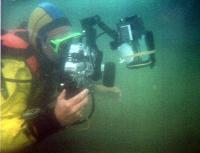 Photograph
by Claire Summers
Photograph
by Claire Summers
After around two years building a Nikonos system I sold it and moved to an Ikelite housing with a Nikon F60. I preferred this set up for macro which is my main interest, particulary in UK waters. I sometimes still miss the simplicity of the Nik V system for wide angle, but the flexibility of an SLR macro lens can't be beaten.
Five years after getting the F60 I moved over to digital with a Nikon D70 again in an Ikelite housing. I love the instant feedback of digital. I was worried that I'd miss TTL flash control but I've found that I'm getting better results with manual flash and the ability to review the shots instantly. Shooting RAW also allows a bit of flexibility in adjusting the exposure in post processing. These two factors more than compensate for the loss of TTL.
My first underwater photographs were taken using print film but I eventually moved over to slides and used Fuji Velvia for all my photography until I went digital. All the early photographs on this site were taken using Velvia.